
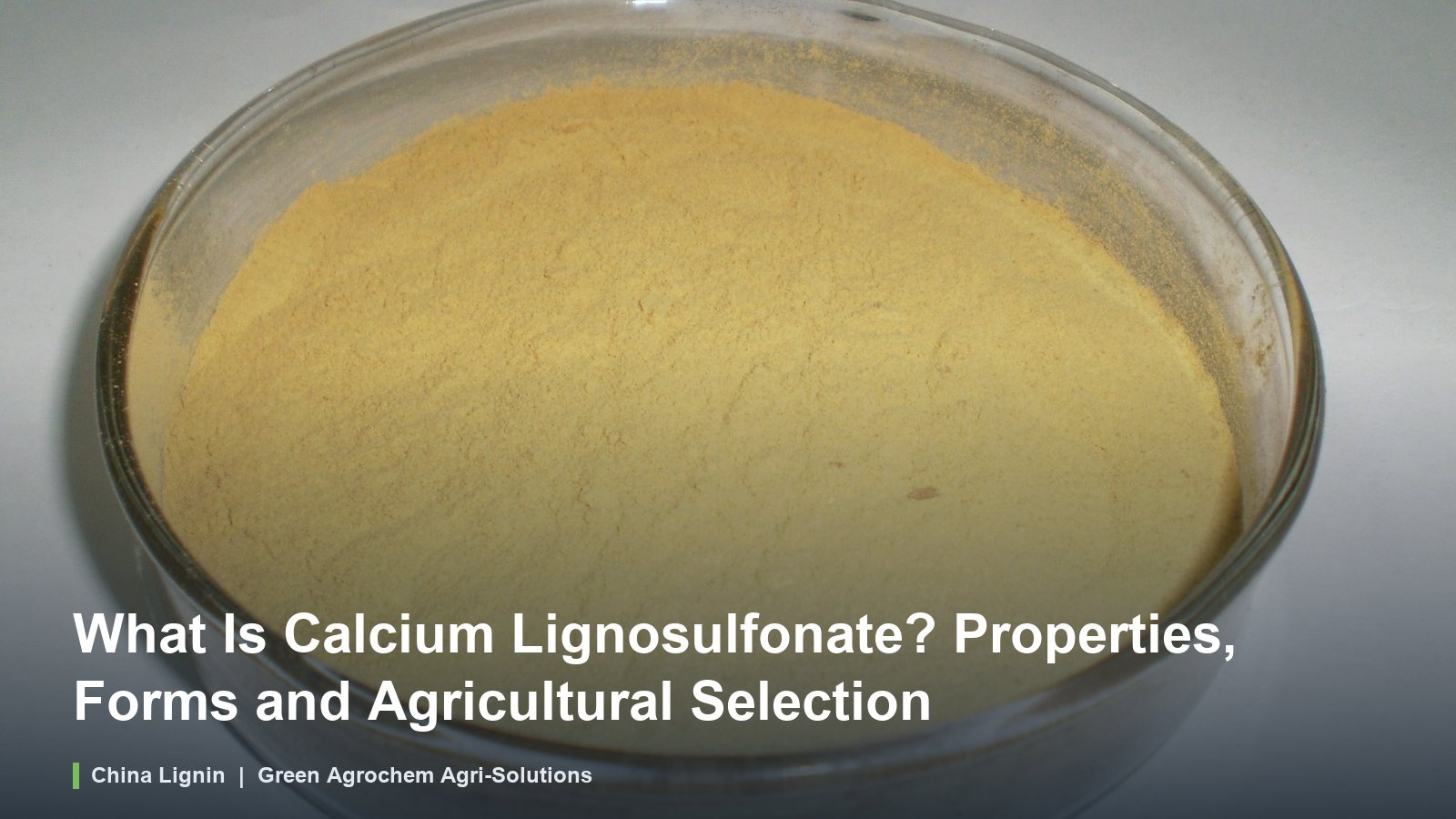
Calcium lignosulfonate is a water-soluble calcium salt of sulfonated lignin, recovered from the sulfite pulping of wood. In agriculture it is used as a granulation binder, a dispersant and a formulation aid in fertilizers, micronutrient products and crop-protection formulations. This page explains what it is, the forms it comes in and where it fits in farm inputs.
- Origin: lignin from wood, made water-soluble by sulfite pulping.
- Form: yellow-brown powder (95% min dry matter) or liquid concentrate.
- Agricultural roles: binder, dispersant, wetting aid, micronutrient complexing.
- Agri-grade spec: 60% min lignosulfonate content (dry basis), 0.2% max insolubles.
What Calcium Lignosulfonate Is
Lignin is the natural polymer that holds wood fibres together. In sulfite pulping, the cooking liquor adds sulfonate groups to lignin so it dissolves and can be separated from the cellulose. The recovered material, with calcium as the counter-ion, is calcium lignosulfonate. It is a mixture of polymer molecules of different sizes, not a single compound, so grades differ in sugar, ash and insoluble content. How production affects quality is covered in lignosulfonate production.
Agricultural Uses
| Use | What it does | Related guide |
|---|---|---|
| Fertilizer granulation | Binds fine particles into granules and adds strength after drying | pellet binder for fertilizer granules |
| Fertilizer formulation | Disperses solids and helps blend components | calcium lignosulfonate fertilizer formulation |
| Micronutrient products | Complexes metal ions such as Fe, Zn and Mn | micronutrient complexes |
| Sprays and wettable powders | Wetting and dispersing aid | foliar spray adjuvant |
| Organic farming inputs | Listed in the US NOP for specific functions | organic farming: is it allowed? |
Forms: Powder and Liquid
| Powder | Liquid | |
|---|---|---|
| Handling | Dry blending or dissolving on site | Metered pumping and spraying |
| Freight | More active material per tonne shipped | Includes water |
| Storage | Keep dry; reseal bags | Check storage stability and temperature |
| Comparison basis | Dry matter | Solids content |
Liquid lignosulfonate in agriculture is covered in how liquid lignosulfonate is used in agriculture.
Agricultural Grade Specification
| Parameter | GAC-CaLS-AGRI (TDS Rev. 2.0) |
|---|---|
| Appearance | Yellow-brown powder |
| Lignosulfonate content | 60% min (dry basis) |
| Dry matter / moisture | 95% min / 5% max |
| Water-insoluble matter | 0.2% max |
| pH | 4–7 |
| Total calcium and magnesium (as sulfate) | 5–6% |
| Sulphate | About 5% |
| Sugar | 15% |
| Total NPK | About 10% |
Typical values from the current TDS. Each lot ships with a COA.
Full property explanations are on calcium lignosulfonate properties for fertilizers and soil.
Calcium vs Sodium Lignosulfonate
Both do similar jobs. Calcium grades are widely used in granulation and blends; sodium grades are chosen where calcium could react with phosphate or sulfate in a formulation. See calcium vs sodium lignosulfonate. Industrial uses such as concrete and dust control are covered by LigninCorp.
FAQ
What is calcium lignosulfonate?
A water-soluble calcium salt of sulfonated lignin, recovered from the sulfite pulping of wood. It is a brown powder or liquid used as a binder, dispersant and formulation aid.
What is calcium lignosulfonate used for in agriculture?
Mainly as a granulation binder for fertilizers, a dispersant in suspensions and wettable powders, a wetting aid in sprays, and a component of micronutrient formulations.
Is it a calcium fertilizer?
Not in practice. The agricultural grade contains 5–6% total calcium and magnesium (as sulfate). It is used for its formulation functions, not as a calcium source.
Powder or liquid?
Powder is easier to ship and store; liquid suits metered spraying. Compare them on a dry-solids basis.